



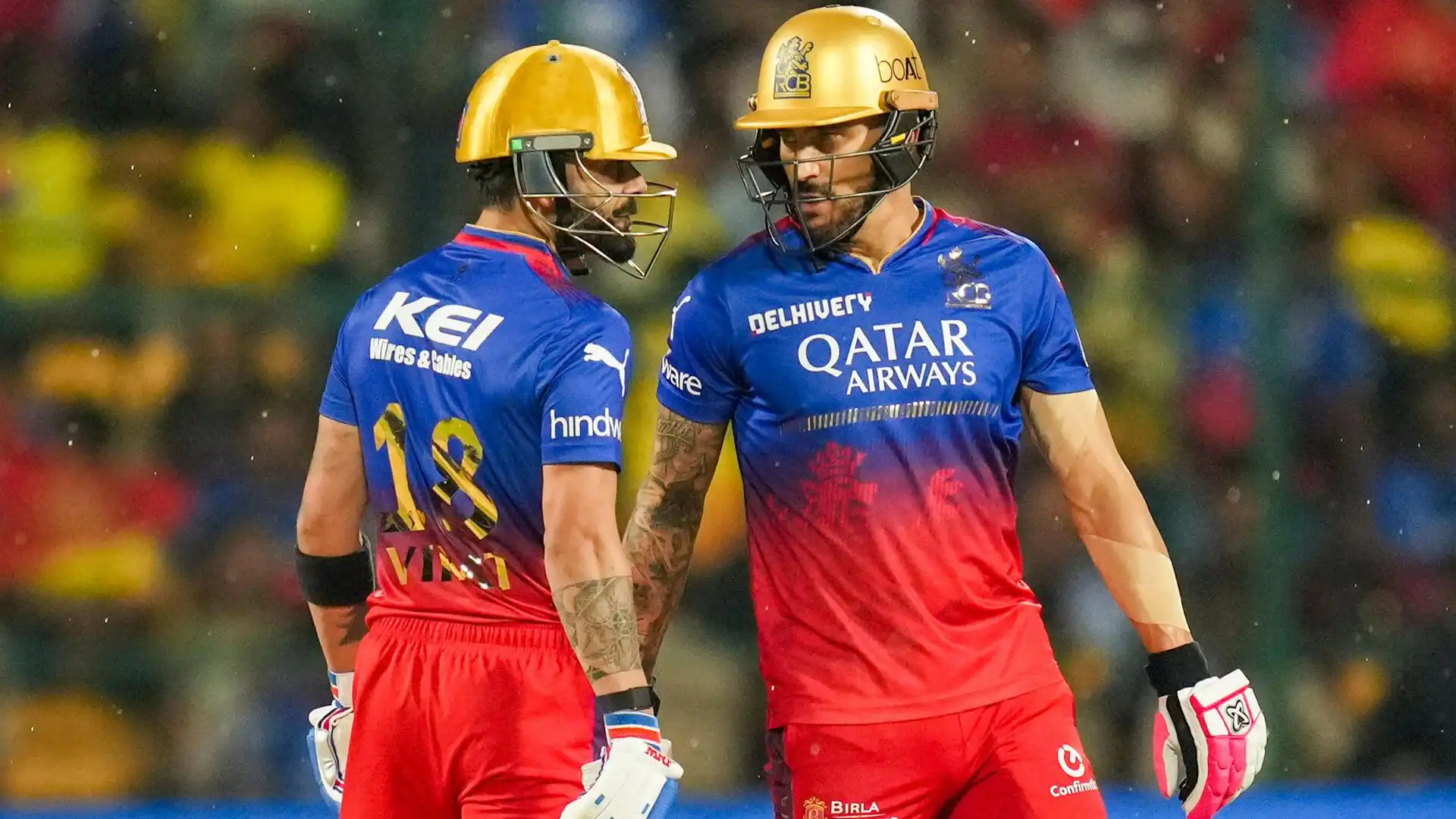
Virat Kohli resigned as captain of Royal Challengers Bengaluru after the 2021 season, and Faf du Plessis assumed the role prior to the 2022 IPL season. In order to manage his workload and concentrate on his batting, Kohli made the decision to resign as captain. The RCB’s director of cricket at the time, Mike Hesson, saw du Plessis as the best person to steer the team into a new era.
Du Plessis asked Kohli directly for clarification regarding the dynamics of team leadership prior to taking the captaincy. He told Kohli that without the support and encouragement of his senior players, the role would not be feasible. During du Plessis’s three seasons in charge, Kohli’s quick encouragement set a good tone for their working relationship. Later, Du Plessis discussed this discussion with Dale Steyn while appearing on Cricketers on Cricketers program.
Kohli sent du Plessis a clear, comforting message. Du Plessis recalled the message he got from the former captain of the RCB, stating:
“I get a message from Virat saying, “Listen, I’m thrilled to have a better captain to replace me.” I’m eager to get you in.
During du Plessis’s three years as the team’s captain, their working relationship was shaped by Kohli’s quick endorsement. Du Plessis was extremely appreciative of Kohli’s support during his time as captain. The South African thought about how Kohli’s encouragement gave him the self-assurance to take on a challenging position at a team with high standards. Du Plessis admitted that his early months as captain might have been much more challenging without that foundation of trust.
Faf du Plessis described how Kohli’s assurance changed the way he approached leadership:
“That support made all the difference between entering that season terrified and confident that I have experience, am a capable leader, and have the man’s support.”
During his first season in charge, he was able to lead with confidence instead of uncertainty thanks to Kohli’s assurance.
Faf du Plessis emphasized the enormous demands of managing Royal Challengers Bengaluru, a team with ardent supporters and persistently lofty goals. He explained how fans and the larger cricket community can demand that Kohli take over as captain after just one defeat. Throughout du Plessis’s tenure, the weight of fan sentiment regarding Kohli’s potential as captain became a constant backdrop.
The particular difficulty of leading RCB in Kohli’s shadow was described by Du Plessis:
“As a captain, I can assure you that everyone in Bengaluru and India wants Virat Kohli to lead the RCB if they lose even one game, let alone two.”
He explained that this feeling was a reflection of the fans’ strong love and faith in Kohli’s leadership skills rather than their discontent with him or any other captain. “It’s not that they dislike me or you. All they want is for Virat Kohli to lead. Therefore, “Virat Kohli should be captain” for every defeat.
This dynamic highlighted the particular difficulty of leading RCB in Kohli’s shadow, where each setback sparked comparisons and conjecture about potential replacements.
During his three years as captain, Du Plessis considered how Kohli’s unwavering support protected him from the full force of that strain. He admitted that the persistent demands for his return would have been much more detrimental to his self-assurance and efficacy as a leader in the absence of Kohli’s support.
Without Virat Kohli’s backing, Faf du Plessis examined the following hypothetical situation:
“How would I have felt during those three years if I hadn’t had that support? It would have been the most challenging situation.
The situation demonstrated how vital Kohli’s support as a senior player had been to du Plessis’s capacity as captain.
Due to his recent resignation as captain of South Africa in 2020, Du Plessis brought a distinct viewpoint to the RCB captaincy. He was able to approach the franchise role with new eyes and a different mindset because, by the time he joined RCB, he was no longer burdened with the responsibilities of international captaincy. Instead of operating in a hierarchical captain-player dynamic, he and Kohli were now performing at the same level as senior players.
Faf du Plessis described how his approach at RCB was influenced by his departure from international captaincy:
“I was a player who had transitioned from captain to non-captain at that point. Now that he’s only a player, I was on the same level as him, so I had a new perspective.”
Because they were both senior players without captaincy duties, their relationship became more harmonious and cooperative.
Beyond the dynamics of captaincy, du Plessis and Kohli forged a sincere friendship that went beyond their RCB careers. Faf du Plessis explained how their relationship developed swiftly and organically, without the usual obstacles that might exist between rival countries. Before joining RCB, the two had played against one another for years, but their bond at the team went beyond that rivalry. “From the beginning, I had his support—more than unconditional support. He’s always supported me.”
Also Read: Shoaib Akhtar on U19 India-Pakistan Clash – ‘Pakistan Were Far Superior’
This steadfast support from Kohli served as the cornerstone around which du Plessis developed both his captaincy and his time with the team. Du Plessis considered how their friendship had developed organically:
“Despite the fact that we had always played against one another, we felt a strong bond right away. It lacked background information and context. It simply occurred immediately.”
Due to their impromptu friendship, du Plessis had a close personal relationship with his most experienced player when he assumed the captaincy, which facilitated a more seamless and successful transition.