


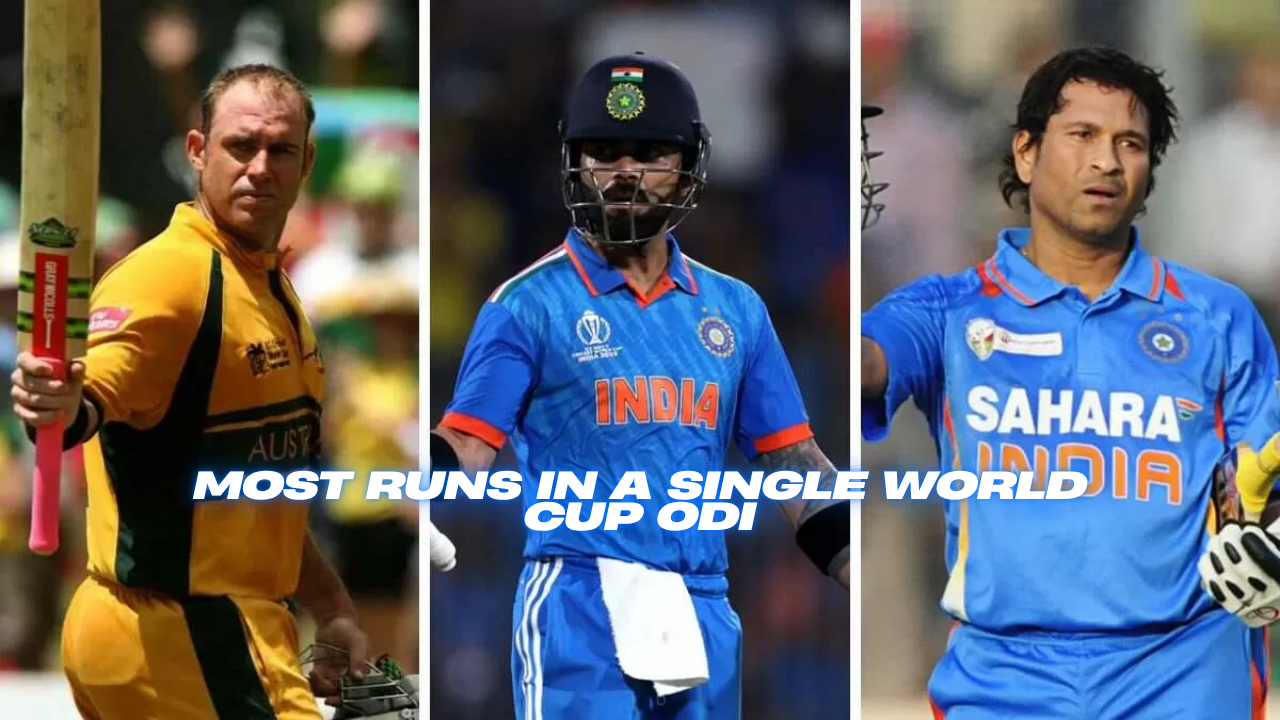
The ICC Men’s Cricket World Cup provides the biggest platform for international cricket, as the world’s top batsmen strive to write their names into the record books. Consistent run-scoring throughout the duration of a World Cup requires a batsman to possess great technique, patience, physical conditioning and mental toughness to perform at his best when the pressure is on. There have been many great performances by some of the most famous batsmen in history during World Cups; however, there are only a handful that have scored 600 or more runs in any one World Cup.
The record for the most runs in a single World Cup ODI belongs to India’s Virat Kohli, who scored 765 runs during the 2023 ODI World Cup. His remarkable campaign surpassed Sachin Tendulkar’s long-standing record of 673 runs, set in the 2003 tournament.
Who Has Scored the Most Runs in a Single World Cup ODI
Virat Kohli has scored the highest number of runs in one men’s ODI World Cup. He compiled 765 runs in 11 innings at the 2023 Cricket World Cup with an average of 95.62. With 3 centuries and 6 half-centuries, Kohli’s campaign is considered as one of the best consistent batting campaigns in World Cup history.
Kohli had many opportunities to score runs against some of the strongest international cricket teams in the world, he was a key part of India’s path to the finals. In addition, Kohli set a new record by scoring more than 673 runs (Tendulkar’s old record), a feat that no other player has accomplished in over 20 years.
The following lists three of the most prolific individual runs scoring campaigns in the history of Men’s One Day International (ODI) World Cups.
Most Runs in a Single ODI World Cup
| Rank | Player | Team | World Cup Year | Runs |
| 1 | Virat Kohli | India | 2023 | 765 |
| 2 | Sachin Tendulkar | India | 2003 | 673 |
| 3 | Rohit Sharma | India | 2019 | 648 |
Kohli’s record stands out because of his ability to combine consistency with big scores. Rather than depending on one or two exceptional innings, he delivered valuable contributions throughout the tournament. Tendulkar and Rohit also demonstrated how a sustained run of strong performances can help a player dominate an entire World Cup edition.
Top 10 Players with the Most Runs in a Single ODI World Cup
The record for the highest run scorer in one ODI World Cup has changed as players have adapted to different conditions, bowling attacks and tournament formats. Some batters built their totals through steady innings, while others combined consistency with aggressive stroke play.
The following table lists ten leading individual run-scoring campaigns in men’s ODI World Cup history.
Top 10 Highest Run Totals in One World Cup Edition
| Rank | Player | Team | World Cup Year | Runs |
| 1 | Virat Kohli | India | 2023 | 765 |
| 2 | Sachin Tendulkar | India | 2003 | 673 |
| 3 | Rohit Sharma | India | 2019 | 648 |
| 4 | David Warner | Australia | 2019 | 647 |
| 5 | Shakib Al Hasan | Bangladesh | 2019 | 606 |
| 6 | Matthew Hayden | Australia | 2007 | 659 |
| 7 | Rohit Sharma | India | 2023 | 597 |
| 8 | Kane Williamson | New Zealand | 2019 | 578 |
| 9 | Quinton de Kock | South Africa | 2023 | 594 |
| 10 | David Warner | Australia | 2023 | 535 |
A major takeaway from these performances is that the highest run totals often come from players whose teams progress deep into the tournament. More matches create additional opportunities to bat, although the number of innings alone does not guarantee success. Batters must also maintain form against different opponents and handle pressure in crucial matches.
Also read this: India vs Pakistan | Smriti Mandhana Stat | Abhishek Sharma
Virat Kohli’s Record-Breaking 2023 World Cup
Virat Kohli produced one of the best single-player batting performances in the history of the Men’s ODI World Cup in 2023. He played in front of his own home crowd and scored 765 runs in 11 innings. This was the first time that someone had broken the previous record for the most runs in a single World Cup tournament.
His campaign had a very consistent theme; Kohli had scored three hundreds and six fifties in his campaign while he was dismissed an average of once every 95.62 runs. He hit at a strike rate of around 90.31, which allowed him to consistently accumulate runs as well as attack when required.
Virat Kohli’s 2023 World Cup Batting Statistics
| Statistic | Record |
| Matches | 11 |
| Innings | 11 |
| Total runs | 765 |
| Batting average | 95.62 |
| Strike rate | 90.31 |
| Centuries | 3 |
| Half-centuries | 6 |
| Highest score | 117 |
Kohli’s century against New Zealand in the semi-final was particularly memorable. He scored 117 runs from 113 balls, recording his 50th ODI century and surpassing Sachin Tendulkar’s record of 49 ODI hundreds.
Although India lost the final to Australia, Kohli’s individual performance earned him the Player of the Tournament award. His achievement demonstrated how technical discipline and consistent scoring can produce a historic World Cup campaign.
Most Runs in a Single World Cup by Indian Players
India has produced several of the leading run scorers in ODI World Cup history. Sachin Tendulkar set the previous single-edition record in 2003, Rohit Sharma led the scoring charts in 2019, and Kohli surpassed both achievements in 2023.
Top Indian Run-Scoring Campaigns
| Player | World Cup Year | Runs | Centuries |
| Virat Kohli | 2023 | 765 | 3 |
| Sachin Tendulkar | 2003 | 673 | 1 |
| Rohit Sharma | 2019 | 648 | 5 |
| Rohit Sharma | 2023 | 597 | 1 |
These performances highlight different approaches to batting success. Tendulkar combined experience with the ability to construct long innings, Rohit Sharma used aggressive stroke play to put pressure on bowling attacks, and Kohli consistently converted starts into substantial scores.
For India, such performances have often provided a strong foundation for successful tournament campaigns. However, individual batting records do not automatically guarantee a championship, as the final result depends on the entire team’s performance.
Most Runs in Each ODI World Cup Edition
The leading run scorer changes from one World Cup to another. Conditions, tournament length, playing styles and the quality of bowling attacks all influence how many runs a batter can accumulate.
| World Cup Year | Leading Run Scorer | Team | Runs |
| 1975 | Glenn Turner | New Zealand | 333 |
| 1979 | Gordon Greenidge | West Indies | 253 |
| 1983 | David Gower | England | 384 |
| 1987 | Graham Gooch | England | 471 |
| 1992 | Martin Crowe | New Zealand | 456 |
| 1996 | Sachin Tendulkar | India | 523 |
| 1999 | Rahul Dravid | India | 461 |
| 2003 | Sachin Tendulkar | India | 673 |
| 2007 | Matthew Hayden | Australia | 659 |
| 2011 | Tillakaratne Dilshan | Sri Lanka | 500 |
| 2015 | Martin Guptill | New Zealand | 547 |
| 2019 | Rohit Sharma | India | 648 |
| 2023 | Virat Kohli | India | 765 |
The figures show how individual run-scoring records have developed over time. The record rose from 673 runs in 2003 to 765 in 2023, reflecting Kohli’s exceptional consistency across the tournament.
It is also worth remembering that tournament formats have changed. A player who gets more innings has more opportunities to build a large aggregate, so total runs should be considered alongside averages, strike rates and the number of matches played.
Most Centuries in a Single ODI World Cup
Centuries are among the most valuable contributions a batter can make in a World Cup. A hundred can help establish a competitive total or guide a team through a difficult chase.
Rohit Sharma set a men’s ODI World Cup record with five centuries in the 2019 edition. Virat Kohli scored three centuries in 2023, while Quinton de Kock also registered four hundreds during that tournament.
| Player | World Cup Year | Centuries | Total Runs |
| Rohit Sharma | 2019 | 5 | 648 |
| Quinton de Kock | 2023 | 4 | 594 |
| Virat Kohli | 2023 | 3 | 765 |
| Sachin Tendulkar | 2003 | 1 | 673 |
Kohli’s campaign shows why the number of centuries alone does not determine the most runs in a single World Cup. His six half-centuries, combined with three hundreds, helped him build a higher overall total than any previous batter.
Most Fifties in a Single ODI World Cup
Half-centuries provide an additional means of measuring consistency. Centuries typically draw the most attention; however, when players consistently score at least 50 runs in each match, this provides a significant advantage throughout a lengthy tournament.
During the 2023 World Cup, Virat Kohli had six half-centuries to go with his three hundreds. In the 2003 World Cup, Sachin Tendulkar also had six half-centuries, which shows that it is better to contribute often to your team instead of trying to put up one great performance.
A batsman that frequently scores 50–80 runs will help stabilize the batting lineup, allowing other players to be more aggressive when batting. This type of player is especially valuable in knockout matches, where a bad innings could eliminate a team from competition.
Highest Batting Average and Best Strike Rate in a World Cup Edition
Runs tell only part of a batter’s story. Batting average indicates how many runs a player scores per dismissal, while strike rate measures how quickly those runs are scored per 100 balls faced.
Kohli’s 2023 World Cup average of 95.62 reflects his ability to score heavily while getting dismissed relatively infrequently. Meanwhile, Rohit Sharma’s 2023 strike rate of approximately 125.94 demonstrates the attacking approach he used to give India fast starts.
| Player | World Cup Year | Runs | Average | Strike Rate |
| Virat Kohli | 2023 | 765 | 95.62 | 90.31 |
| Rohit Sharma | 2019 | 648 | 81.00 | 98.33 |
| Rohit Sharma | 2023 | 597 | 54.27 | 125.94 |
These figures illustrate the different approaches of leading run scorers; averages and strike rates should be verified against the relevant official scorecards before publication.
Neither a high average nor an aggressive strike rate alone defines the best tournament. The strongest campaigns combine scoring volume, consistency and an ability to adapt to the match situation.
Most Runs in a Single World Cup: 2019 vs 2023
The 2019 and 2023 editions produced some of the greatest individual batting campaigns in men’s ODI World Cup history. Rohit Sharma topped the scoring charts in 2019 with 648 runs, while Kohli broke the record four years later with 765.
| Statistic | 2019 World Cup | 2023 World Cup |
| Leading run scorer | Rohit Sharma | Virat Kohli |
| Runs | 648 | 765 |
| Matches played | 9 | 11 |
| Centuries | 5 | 3 |
| Second-highest scorer | David Warner, 647 | Rohit Sharma, 597 |
Rohit’s five centuries in 2019 were a defining feature of his campaign. Kohli’s 2023 performance, on the other hand, combined three centuries with six fifties and a remarkable average. Both players demonstrated that different batting styles can succeed at the highest level.
The comparison also shows why tournament opportunities matter. Kohli played 11 matches in 2023, whereas Rohit played nine in 2019. Even after considering the extra opportunities, Kohli’s scoring rate and consistency made his campaign historic.
How Has the Single-Edition World Cup Run Record Changed
The highest number of runs in a single World Cup has grown steadily since the early days of the tournament. More recent editions of the World Cup provide leading players with more opportunities to bat because there are more teams participating, and therefore, more matches are being played.
The use of improved batting equipment, fitness, training techniques and modern offensive tactics have affected how many runs can be scored during a One Day International (ODI). Batters now have more confidence in trying to hit the ball over the boundary line, taking singles and keeping the opposition on their toes during each inning.
The fact that Kohli has broken this record does not mean that the conditions of today are what enabled him to do so. In order for a batsman to achieve such records, he must be able to bat against various types of bowlers, adjust to different pitches as they change during the course of a tournament and focus on his game for long periods of time. Kohli’s 765 runs in 2023 were a combination of both opportunities presented to him and how he executed those opportunities.
Conclusion
The most runs in a single World Cup ODI represents the consistency needed to win the most prestigious event in all of cricket. At present, Virat Kohli holds the record for scoring 765 runs in 2023. This is followed by Sachin Tendulkar who scored 673 runs in 2003, and Matthew Hayden who scored 659 runs in 2007.
Rohit Sharma has five hundreds in 2019 alone, while Virat Kohli has a mix of hundreds and fifties showing that there are multiple ways to control a World Cup. At the end of the day, some of the best individual performances in World Cup history have been based upon being consistent, adaptable and able to produce runs at crucial times for the team.
While the next ODI World Cups present opportunities for new talent to break into the world of cricket, Kohli’s records will continue to serve as a standard for those players who wish to leave a legacy in the sport.
FAQs
Q1. Who has scored the most runs in a single ODI World Cup?
Virat Kohli holds the record, having scored 765 runs for India in the 2023 Men’s ODI Cricket World Cup.
Q2. How many runs did Virat Kohli score in the 2023 World Cup?
Kohli scored 765 runs in 11 innings, including three centuries and six half-centuries. He averaged 95.62 runs per dismissal.
Q3. Who held the record before Virat Kohli?
Sachin Tendulkar held the record with 673 runs in the 2003 ODI World Cup. Kohli surpassed that total during the 2023 tournament.
Q4. How many runs did Sachin Tendulkar score in the 2003 World Cup?
Tendulkar scored 673 runs in 11 matches in the 2003 World Cup, including one century. His performance helped India reach the final.
Q5. Who scored the most runs in the 2019 ODI World Cup?
Rohit Sharma was the leading run scorer in 2019, finishing with 648 runs in nine matches and scoring five centuries.