In the second Test at Gqeberha, Australia’s batting unit collapsed for 99 in the first innings, forcing the team to follow on after South Africa recovered to 425. The team’s incapacity to form alliances during the collapse was acknowledged by coach Andrew McDonald. The game took place as part of Australia’s tour of South Africa from October 18 to October 22, 2026. Australia led the three-match series 1-0 after winning the first Test in Durban by 214 runs, but the Gqeberha performance revealed serious flaws in the batting lineup.
In Test cricket, this was only the third time since 1988 that Australia had been put in that situation. Australia ended day four on 156 for 4 after reaching 100 for 1 in the second innings, but they still needed 170 more runs to prevent South Africa from having to bat again. Marnus Labuschagne’s dismissal, lofting to mid-on, gave the South African bowlers a late-afternoon rally, while Travis Head remained undefeated at 87.
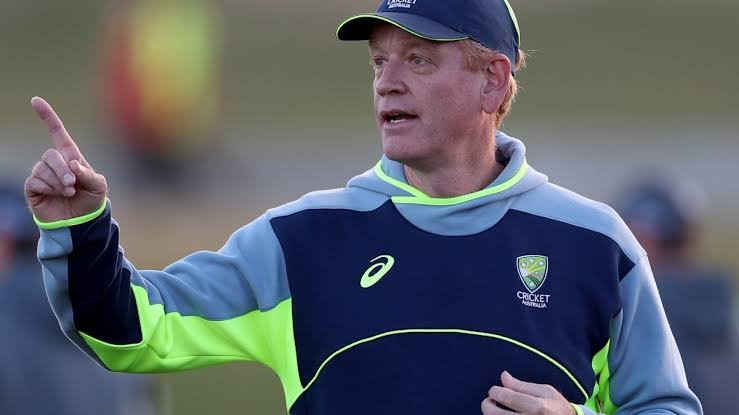
The team’s incapacity to form alliances during the collapse was acknowledged by coach Andrew McDonald. Australia’s hitters were unable to successfully counter the threat throughout the innings due to the South African bowling attack’s constant pressure. However, there was a batter error there, and while I believe we are better than that, I am unable to defend it at this time,” Andrew McDonald stated. We weren’t able to form any partnerships because, in my opinion, it takes a few players to communicate and work through things when they happen so quickly,” he continued.
Andrew McDonald’s evaluation of the failure
Andrew McDonald considered the difference between Australia’s performance in the first Test and their recent form. He expressed confidence in the team’s ability to bounce back for the final Test at Cape Town, which is set for October 27–31, 2026, despite the Gqeberha setback. We’re not a flawless batting unit, and I’ve never claimed that we are,” Andrew McDonald remarked. “We’ve had some of these moments throughout the journey.”
Andrew McDonald emphasized the team’s overall performance and the necessity of keeping perspective during a trying time, resisting the urge to criticize specific players. He admitted that Australia’s batting consistency had been called into question by their recent performances, especially in light of their defeat against Bangladesh in Darwin and their loss to South Africa in the World Test Championship final last year. As we sit here today, we are beginning to defend a team that has done incredibly well.
A grab-and-talk about the drawbacks, what should be done, and what should be moved will be what you’re looking for. McDonald stated, “I’m not going to sit here and hang anyone out to dry because this team has been a really consistent team over a long period of time.”
Australia’s demise was largely caused by South Africa’s bowling attack. When Kagiso Rabada returned to the team, he had an impact, while Marco Jansen took 5 for 33 with the ball. South Africa’s performance in the second innings was largely due to Simon Harmer. During the game, Anrich Nortje was hurt. South Africa’s comeback from 97 for 5 on day two to a total of 425 showed the team’s tenacity and the potency of their bowling unit.
Also Read: Towhid Hridoy Opens Up on Bangladesh’s ODI Woes
Cameron Green is one of Australia’s options for a specialist batter in the final Test. Green is still available for selection but is unlikely to bowl after suffering an abdominal strain during an ODI in late September. Despite slipping down the batting order due to a neck issue, Steven Smith was confirmed to play on the last day. Other batting options for the team include Josh Inglis and Cooper Connolly; uncapped Sam Harper was called up to the tour after Inglis was unable to play in the first Test due to a fractured finger.
Although Australia had not lost a Test series since traveling to India in 2023, their batting consistency had come under scrutiny due to recent performances. Concerns regarding the batting unit’s dependability under duress were raised by the team’s recent loss to Bangladesh in Darwin and their loss to South Africa in the World Test Championship final last year.