


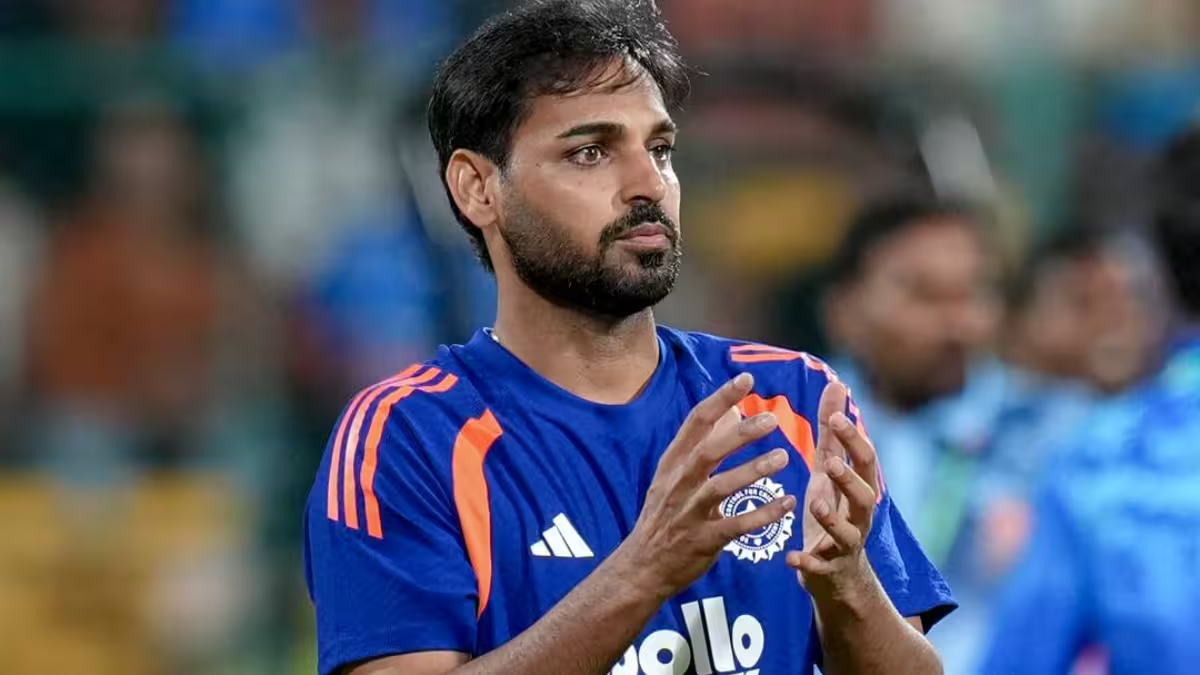
After a nearly four-year hiatus, Bhuvneshwar Kumar returned to the international scene by playing in India’s final Twenty20 International against the West Indies and the first two Twenty20 Internationals against New Zealand in Christchurch. During his comeback matches, the 36-year-old pacer, who was called up to the team in Jasprit Bumrah’s absence, encountered difficult circumstances and found it difficult to settle into a rhythm.
His first two matches against the Kiwis yielded mediocre results: 4 overs for 49 runs without a wicket in the first, and 4 overs for 50 runs at Hagley Oval on Saturday in the second Twenty20 International with a single dismissal of Daryl Mitchell. In the absence of Jasprit Bumrah, his expertise and experience are crucial, Southee told.
Why has Bhuvneshwar had trouble in his first games?
In the first Twenty20 International, where India chased down 226 runs, it was especially clear that the Christchurch pitches offered batting-friendly conditions. Southee ascribed some of the bowling challenges to the characteristics of contemporary white-ball cricket and the available surfaces. He clarified that bowlers are now forced to use non-traditional seam-based techniques due to the lack of swing movement early in the innings. Indeed, it’s a fascinating one. You see a little swing for the first over, but the ball hasn’t swung in white-ball cricket for a while, in my opinion,” Southee remarked.
Bhuvneshwar was mostly used by Indian captain Shreyas Iyer during the Powerplay phase of the second Twenty20 International. He struggled to contain the New Zealand hitters, as evidenced by his third over of that spell going for 17 runs. When Bhuvneshwar was asked to bowl the sixteenth over later in the innings, he gave up eighteen runs. He had bowled the last over in the first Twenty20 International, which went for 14 runs. It takes flexibility and adaptability to be a bowler. Prince Yedav’s presence, in my opinion, somewhat offset that,” Southee remarked.
Also Read: Cameron Green Declares Himself Fit for 3rd Test
Bhuvneshwar’s control with the new ball is one statistical issue from the first two games. He has bowled three no-balls and five wides in the two games, which is noteworthy because prior to this series, he had never bowled a no-ball in any of his 88 T20Is. These errors highlight the difficulties he has adjusting to his prolonged absence from international cricket.
In the remaining games of the series, Bhuvneshwar, a seasoned campaigner with a wealth of experience, will be expected to use his technical expertise and mental toughness to turn the tide. His ability to adjust will be essential to his contribution to India’s campaign because the international format requires a different degree of intensity and accuracy than domestic league cricket.